 TrickExprt Android Apps, Games, Software & Tech Guides

Last updated: 21 November 2026
Quick answer: Gemini 4 Hydrogen just made Google’s AI two and a half times faster — and it is already rolling out to the free Gemini app on your phone. Announced on 12 November 2026, Gemini 4 Hydrogen is the fast, everyday-work model of Google’s new Gemini 4 family. It finishes tasks 2.5 times faster than Gemini 3.8 Flash, scores 57% on the Terminal-Bench coding test where Flash managed only 18.2%, and it is rolling out in the Gemini app, Google Search, Google AI Studio and the Gemini API — including a free tier. The catch: the rollout is staged, so it may not have reached your account yet, and for developers it costs about double what Flash costs until the end of the year.
What Is Gemini 4 Hydrogen?
If you have used the Gemini app at all this year, you have probably been talking to Gemini 3.8 Flash — the quick, everyday model Google put behind the free app. Gemini 4 Hydrogen is its replacement, and it is a much bigger jump than the name suggests.
Google’s Gemini 4 family has three models, and they have different jobs. Gemini 4 Carbon and Gemini 4 Argon are the frontier models — the deep thinkers Google built for hard, long-horizon reasoning, the kind of work where a model spends a long time thinking through architecture or untangling a nasty bug. Gemini 4 Hydrogen is the fast worker of the family. Google built it for rapid execution: writing code, running tests, checking the results, calling tools, and chaining several steps together without making you wait.
That word — agentic — shows up everywhere in Google’s announcement, so here is what it actually means for you. An agentic model does not just answer one question and stop. You give it a job — “plan my Dubai trip under ₹40,000”, “find the bug in this file and fix it”, “turn this 200-page PDF into a one-page summary” — and it works through the steps itself: searching, reading files, running code, checking its own work, and coming back with a finished result. Gemini 4 Hydrogen is the model Google wants doing that everyday work, because it is fast enough that you do not feel the wait.
Gemini 4 Hydrogen at a glance
| Announced | 12 November 2026 (Google blog, updated 16 November) |
| Model ID (for developers) | gemini-4-hydrogen — generally available, no preview label |
| Role | Fast everyday model for coding, agents and document work |
| Context window | 1 million tokens in, up to 1 million tokens out |
| Thinking levels | Low, medium, high (default), xhigh |
| Speed vs Gemini 3.8 Flash | 2.5x faster at the default high setting |
| Price (API, paid tier) | $1.50 per million input tokens, $7.50 per million output tokens |
| Free tier | Yes — in the Gemini API and Google AI Studio, rate-limited |
| Where it runs | Gemini app, Google Search, AI Studio, Gemini API, Gemini for business, Antigravity (Pro/Ultra) |
The 1 million-token context window matters more than it sounds. A million tokens is roughly 750,000 words — enough to drop in a whole codebase, a stack of PDFs, or hours of recorded video and ask questions about all of it at once. Hydrogen can also take text, images, audio and video as input, and pull tables and charts out of spreadsheets and documents.
How Fast Is Gemini 4 Hydrogen, Really?
“2.5 times faster” is the headline, but a speed claim means nothing without the test behind it. Here are the numbers Google published at launch — and the honest context around them.
The big one is Terminal-Bench 4.1, a test where an AI agent has to do real work in a terminal: install things, run code, fix errors, finish a task. Gemini 4 Hydrogen completed 57% of the tasks. Gemini 3.8 Flash managed 18.2%. That is more than triple — and it is the number that explains why Google is replacing Flash with Hydrogen instead of just updating it.
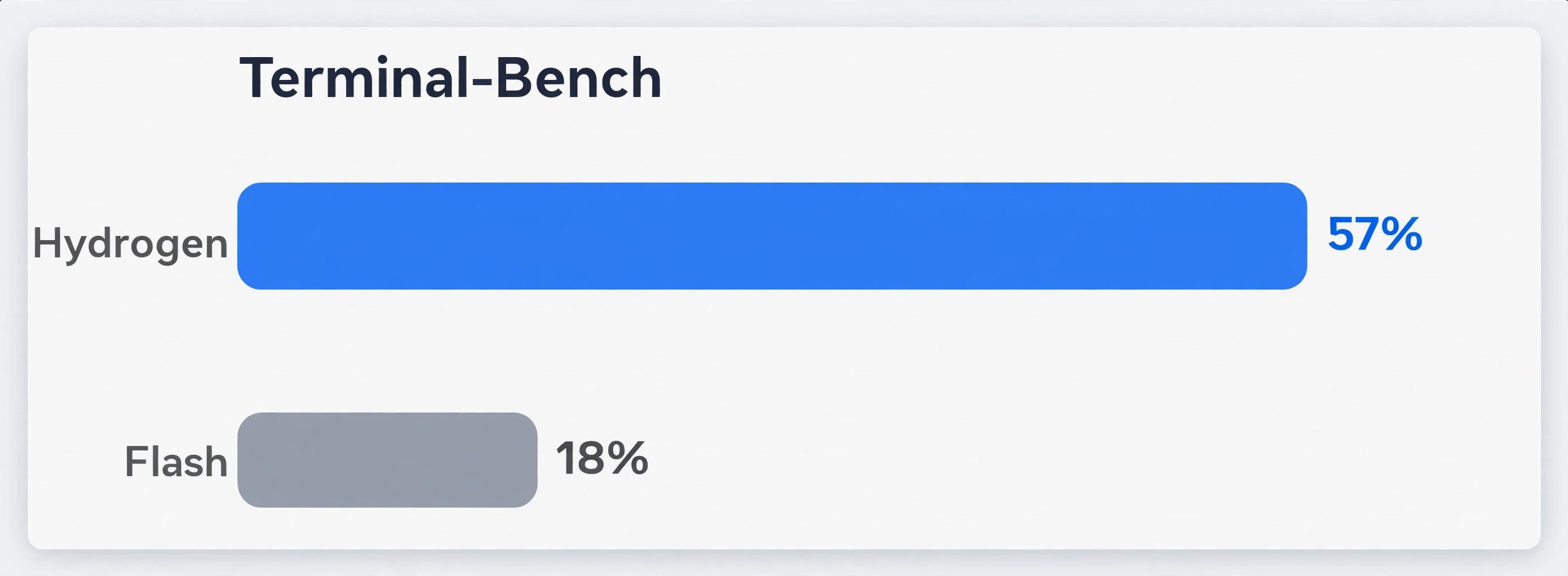
On the Artificial Analysis Intelligence Index, which rolls nine different evaluations into one score, Gemini 4 Hydrogen scores 51 at its default high thinking level and 54 at its highest xhigh setting. That puts it ahead of its own bigger sibling Gemini 4 Argon (50) and far ahead of Flash (31). It also cuts fabricated claims — the model making things up — by more than 5 times compared with Flash, and it recovers better when a tool call fails or a search comes back empty, by trying another approach instead of giving up.
Google also ran Gemini 4 Hydrogen with real partners before launch. Across complex enterprise workflows, partners saw Hydrogen run 2 to 2.8 times faster while using 12% to 23% fewer tokens than Flash. Box, the file-storage company, tested it on its own agent work: accuracy went from 74% with Flash to 79% with Hydrogen, in less than half the time, using about 12% fewer tokens.
One number worth knowing for balance: on that same Terminal-Bench test, Google’s own comparison table shows Claude Sonnet 5.5 ahead at 63.9%. Hydrogen is a big jump over Flash, but it is not the best coding model on the market — it is the fastest one Google makes for everyday work.
And one honest caveat: most benchmark numbers in this section come from Google’s own launch materials, while the Intelligence Index scores and the cost-per-task figures come from Artificial Analysis, an independent benchmarker. Independent re-testing was thin in the first days after release, so treat these as claims, not settled fact. The direction is clear — Hydrogen is much faster than Flash — but the exact percentages will get sharper as independent testers publish their own runs.
The Four Thinking Levels
Gemini 4 Hydrogen adds a new xhigh tier to the thinking levels — low, medium, high, and xhigh. The thinking level is how hard Gemini 4 Hydrogen thinks before it answers, and it is your main control over speed, quality and cost.
- Low — fastest and cheapest. Good for simple jobs: short answers, quick rewrites, “what does this error mean?”
- Medium — a balance. Everyday questions, summaries, and straightforward coding help.
- High (default) — the setting Google ships it with. This is where the 2.5x speed and 57% Terminal-Bench numbers come from. Use it for real work: debugging, multi-step tasks, research.
- Xhigh — the deepest thinking Hydrogen offers. It lifts the Intelligence Index score from 51 to 54. Use it when accuracy matters more than speed — a tricky bug, a long document, a decision you will act on.
The practical rule: leave Gemini 4 Hydrogen on high. Move to xhigh only when a job is important enough to wait a little longer for, and drop to low or medium when you are just chatting or doing something trivial. You pay for thinking, so there is no reason to burn the deepest level on a one-line question.
Gemini 4 Hydrogen vs Gemini 3.8 Flash
For most readers, this is the only comparison that matters — because Flash is what you have been using, and Hydrogen is what replaces it.
| Gemini 4 Hydrogen | Gemini 3.8 Flash | |
| Speed | 2.5x faster than Flash at default | Baseline |
| Terminal-Bench 4.1 | 57% | 18.2% |
| Intelligence Index | 51 (high) / 54 (xhigh) | 31 |
| Fabricated claims | More than 5x fewer | Baseline |
| Thinking levels | Low, medium, high, xhigh | Up to high |
| Context window | 1 million tokens | 1 million tokens |
| API price (input / output per 1M tokens) | $1.50 / $7.50 | $0.75 / $3.75 until 31 Dec 2026, then $1.50 / $7.50 |
| Free tier (API + AI Studio) | Yes, rate-limited | Yes |
| Best for | Everyday coding, agents, document work | Being replaced |
The price row is the one people misunderstand. Yes, Hydrogen costs about double what Flash costs per token until the end of the year. But a token is not a finished job. Hydrogen finishes tasks faster and with fewer retries — remember the 12% to 23% fewer tokens partners reported, and the fact that it solves more than three times as many terminal tasks on the first try. Independent analysis of the benchmark data found Hydrogen actually has a lower estimated cost per benchmark task than Flash ($1.87 against $7.77 at the high setting), because Flash burns tokens on failed attempts. From 1 January 2027, the per-token prices are identical anyway — Flash rises to $1.50 / $7.50 — so the price argument for staying on Flash disappears with the new year.
If you build with Flash: what changes
Developers moving an app from Flash to Hydrogen should know three things before they switch the model name. First, Hydrogen defaults to high reasoning (Flash defaulted to medium) and adds the xhigh level. Second, it rejects the old thinking_budget parameter and the MINIMAL setting — code that passes those will fail. Third, automatic caching now starts at 4,096 tokens instead of 6,144, and explicit caching is unavailable at launch. Google has published a migration guide for the move; check it before you change a production app. And one piece of good news: Google’s deprecation schedule lists no shutdown date for Flash, so nothing breaks on 1 January — Flash just costs the same as Hydrogen from then on.
Where to Try Gemini 4 Hydrogen Free
This is the part that trips people up, so here it is plainly: Gemini 4 Hydrogen is rolling out globally, but the rollout is staged. Google says it is bringing Gemini 4 to everyone, for all tiers — but “rolling out” means your account might get it today, or next week. Do not assume something is broken if you cannot see it yet. Here is where to look, in order.
In the Gemini app (free)
- Update the Gemini app from the Google Play Store. An old version may not show the new model at all. If you have not installed Gemini yet, see our guide on downloading the Gemini AI app free.
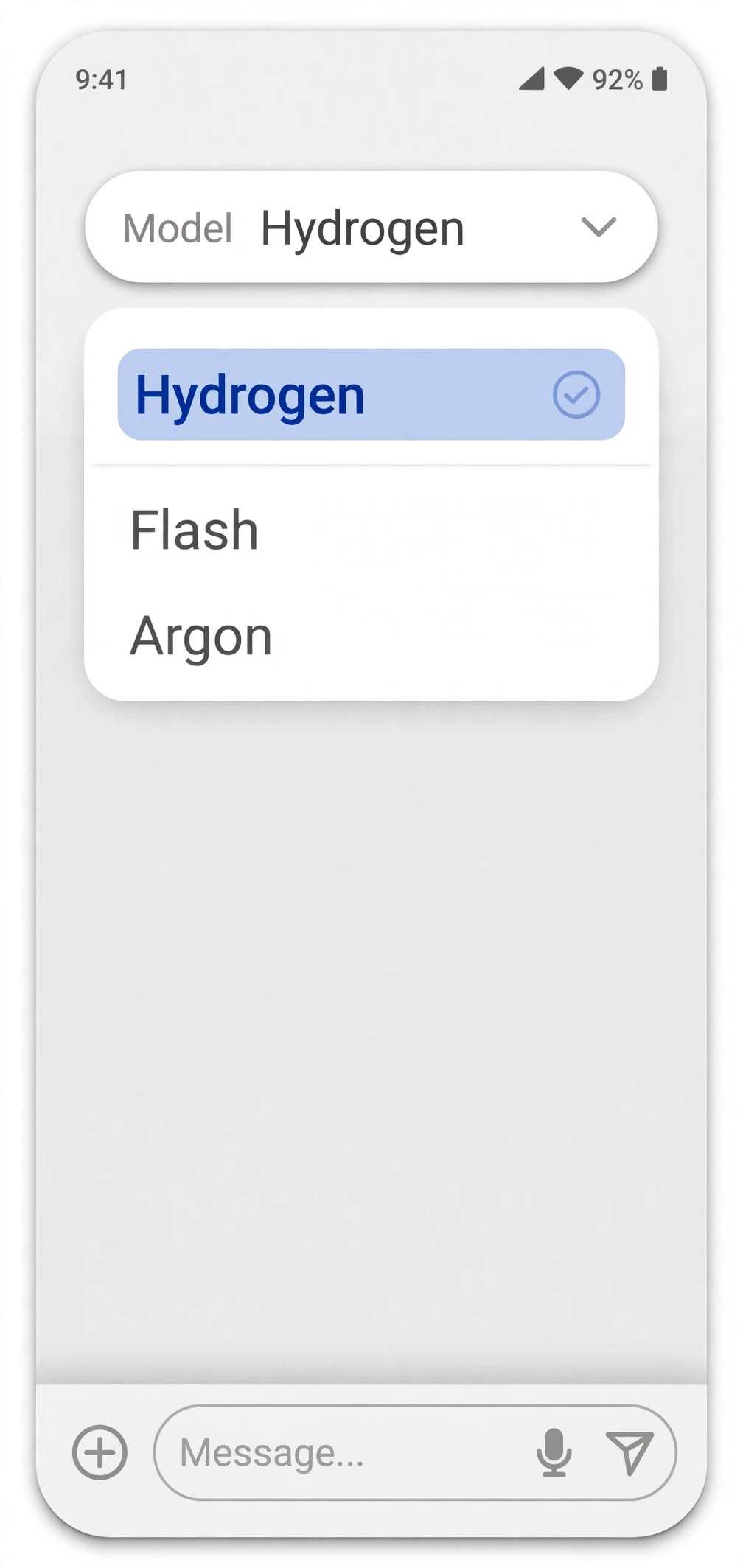
- Open the app and tap the model picker — the dropdown at the top of the chat screen.
- Look for Hydrogen in the list. On free accounts, Google gives Hydrogen through automatic model selection: you may not see a button labelled Hydrogen at all. Instead, Gemini picks the model itself when your prompt fits it — coding, research, multi-step jobs. If the picker shows it, you can select it directly.
In Google AI Studio (free tier)
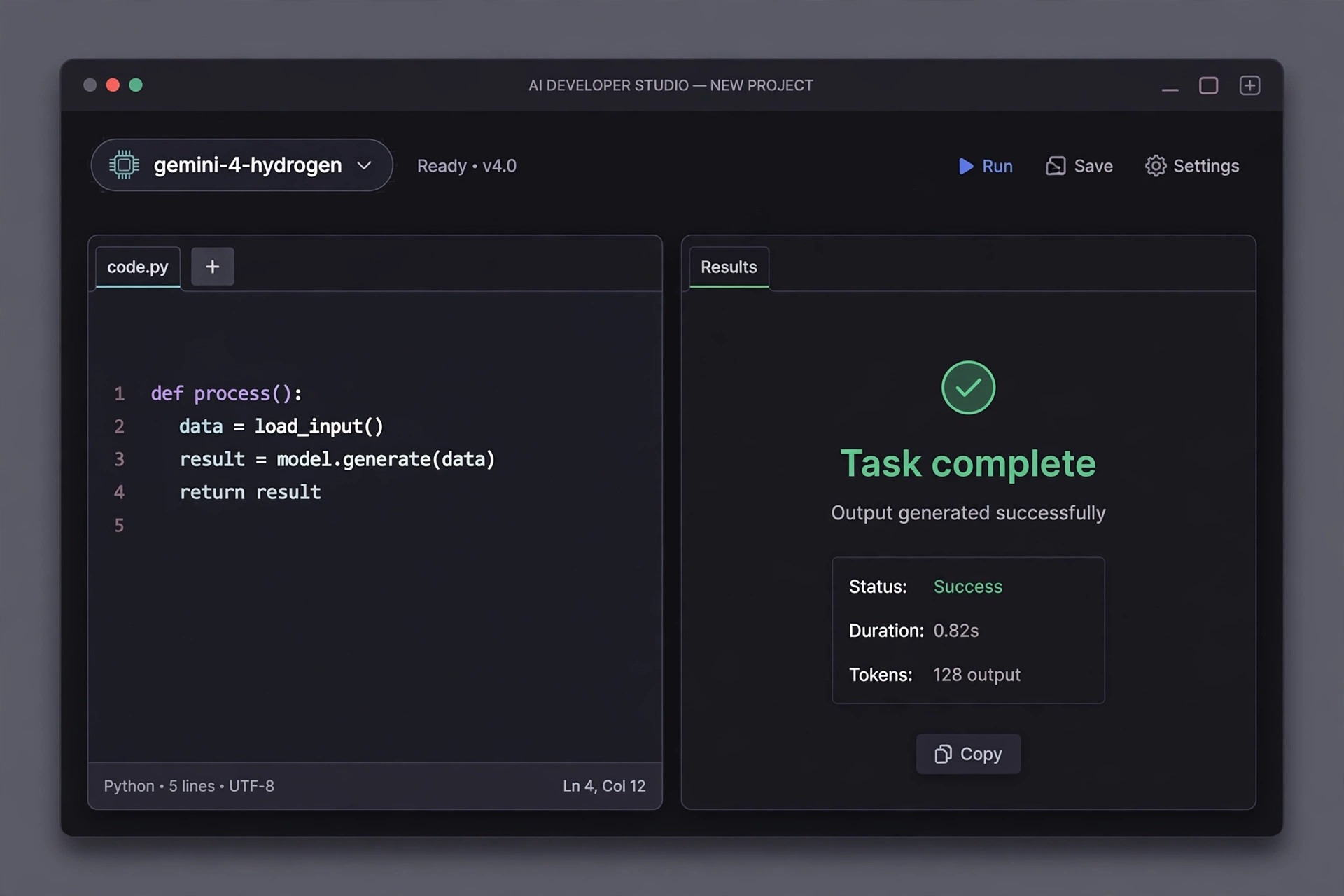
AI Studio is the fastest way to try Gemini 4 Hydrogen properly, because there you choose the model yourself.
- Go to Google AI Studio and sign in with your Google account.
- Start a new prompt and open the model dropdown.
- Select
gemini-4-hydrogen. - Type a real job — not “hello”, something you actually need — and watch how it handles it. Try a coding task or a long document summary; that is where the speed shows.
There is also a free tier in the Gemini API and AI Studio — rate-limited, so heavy use will hit a cap. Check Google’s pricing page for the current limits before building anything serious on the free tier.
In Google Search
Hydrogen is also rolling out in Google Search for all users, where it powers better answers: it understands multi-part questions and typos, gives more visual, scannable responses, and connects you to a wider range of links. You do not need to do anything — it arrives with the rollout.
In Antigravity and Sheets (paid)
Paid Google AI Pro and Ultra subscribers can try Gemini 4 Hydrogen in Google Antigravity, Google’s agent-first development environment, and in Gemini in Google Sheets (starting with Pro and Ultra subscribers). Business users get it through Gemini for business via the API or the model dropdown.
If the Gemini app on your phone starts misbehaving after an update — crashing, freezing, or refusing to open — it is usually the app, not the new model. Our guide on how to fix apps crashing on Android walks through the fixes in order.
What Does Gemini 4 Hydrogen Cost?
For normal users in the Gemini app and Google Search, Gemini 4 Hydrogen costs nothing extra — it is part of the free app and the free search experience. The money question only matters if you pay for API access or a Google AI plan.
| Input (per 1M tokens) | Output (per 1M tokens) | |
| Gemini 4 Hydrogen | $1.50 | $7.50 |
| Gemini 3.8 Flash (until 31 Dec 2026) | $0.75 | $3.75 |
| Gemini 3.8 Flash (from 1 Jan 2027) | $1.50 | $7.50 |
A few details that matter if you are paying for Gemini 4 Hydrogen: the price is flat across the whole 1 million-token context window — no surcharge for long documents. Cached input costs $0.075 per million tokens. Batch, Flex and Contributor tiers cost half the standard rates. And there is no introductory promotion on Hydrogen’s standard tier, so the price you see is the price.
For the Gemini 4 family as a whole, Google’s announced pricing puts the bigger models above Hydrogen: Gemini 4 Argon and Gemini 4 Carbon were announced at $2 input / $10 output as introductory pricing, rising to $4 / $20 afterwards. Hydrogen is the cheapest Gemini 4 model to run — and the only one with a free tier.
What Changes for Normal Users
Forget the benchmarks for a minute. Here is what Gemini 4 Hydrogen actually changes when you open the Gemini app tomorrow.
It follows instructions better. Hydrogen sticks closer to your tone, your format and your specific rules, so email drafts, study guides and rewrites come back ready to use on the first try instead of needing three rounds of corrections. It also follows multi-turn conversations more closely — it remembers what you asked two messages ago and stays on track.
It uses your stuff. Hydrogen pulls context from your uploads and from Google apps like Gmail and Google Drive, and from Connected Apps like Airtable and Dropbox. Ask it to plan your week and it can actually look at your calendar. Ask it to summarise a report and it can read the file.
It does real jobs in the background. This is the one most people will feel first. Gemini Tasks — the agent mode that takes a whole job and works on it in the background — now runs on Gemini 4 Hydrogen. Tasks went free in India on 17 November 2026, the same week Hydrogen launched, and Google says it runs on the new model. If you want the step-by-step version, see our guide on how to use Gemini Tasks free in India.
Search gets smarter. With Hydrogen behind it, Google Search understands questions asked in your natural flow of thought — even multi-part questions and badly typed ones — and answers with more visual, easy-to-scan responses and a wider range of links than before.
The Parts Nobody Talks About: Safety and Teamwork
Speed is the headline, but Google spent a surprising amount of the Gemini 4 Hydrogen launch post on safety — and for a model built to take actions on your behalf, that matters.
Hydrogen reduces overreach in agentic tasks by up to 81% — that is the model doing things you did not ask it to do — and under-service by up to 79%, which is the model quietly doing less than you asked. It cuts misaligned actions and task shortcutting by 12 times, is up to 2 times less likely to bypass permission boundaries when a task is blocked, and scores 94% on Google’s internal agent honesty test. Against indirect prompt injection — hidden instructions smuggled into web pages or documents to hijack the model — it is more than 2.3 times more resilient than before. It also keeps 99.9% of its chain-of-thought readable, with no deceptive reasoning edits across more than 200,000 audited turns.
Then there is Orchestrator, a new option in Google Antigravity that switches between Carbon and Hydrogen inside one task. Carbon plans or untangles the hard problem; Hydrogen does the edits, the test runs and the parallel subagent work. On Terminal-Bench 4.0, that combination reached near-Carbon success rates while using 24% less quota and finishing 19% faster. You do not need Antigravity to benefit from the idea, though: the pattern works in your head too. Use the smart model to plan, the fast model to execute.
The Honest Limits of Gemini 4 Hydrogen
A good guide says what a thing cannot do, not just what it can. Here are Gemini 4 Hydrogen’s real limits.
Gemini 4 Hydrogen is not the deepest thinker. For genuinely hard reasoning — complex architecture, security analysis, deep science — Google still points you to Gemini 4 Carbon and Argon. Hydrogen is fast and capable, but it is the execution engine, not the chief architect. If a task needs hours of careful thought, the frontier models are the right tool.
The benchmarks come from Google — and one independent tester. Most speed and accuracy numbers in this article come from Google’s launch materials or Google’s own comparison tables; the Intelligence Index scores and the estimated cost per benchmark task come from Artificial Analysis. Independent testing was thin in the first days after launch. The gap over Flash is large enough that the direction is not in doubt, but treat the exact percentages as claims, not settled measurements.
The Gemini 4 Hydrogen free rollout is staged. The Gemini app gives Hydrogen to free users through automatic model selection, and the full rollout reaches accounts at different times. If you cannot see it yet, that is the rollout, not a bug on your phone. Paid tiers get it first in some surfaces — Antigravity needs a Pro or Ultra subscription.
Gemini 4 Hydrogen can still be wrong. It cuts fabricated claims by more than 5 times, which is a real improvement — and still not zero. Check anything important before you act on it: a price, a date, a medical fact, a piece of code you are about to run in production.
Should You Switch to Gemini 4 Hydrogen?
Switch now if: you use the Gemini app every day for writing, research, planning or coding; you run tasks in the background with Gemini Tasks; or you build apps on the Gemini API and your Flash bill is mostly retries. Hydrogen is already rolling out to you, and from 1 January it costs the same as Flash anyway.
Wait a little if: you are on a free account and Hydrogen has not reached you yet — there is nothing to do but wait for the rollout, and paying for Pro just to get it early is not worth it for most people.
Stick with Flash until 31 December if: you are a developer with a working Flash integration and no time to test the migration — Flash is cheaper per token until year-end, Google lists no shutdown date for it, and the migration needs a small code change (the removed thinking_budget parameter). Plan the move for January, when the prices match.
For everyone else, the answer is simple: the next time you open the Gemini app, you are probably already talking to Gemini 4 Hydrogen — and you will notice it most in the jobs that used to take three tries.
Frequently Asked Questions
Is Gemini 4 Hydrogen free?
The Gemini app and Google Search are free, and Hydrogen is rolling out there for everyone, including free users — in the app it arrives through automatic model selection. There is also a free tier in the Gemini API and Google AI Studio, with rate limits. Paid API use costs $1.50 per million input tokens and $7.50 per million output tokens.
When was Gemini 4 Hydrogen released?
Google announced it on 12 November 2026, and it was generally available the same day in the Gemini API and AI Studio, with the rollout to the Gemini app and Google Search following. The launch blog post was last updated on 16 November 2026.
Is Gemini 4 Hydrogen better than Gemini 3.8 Flash?
Yes, on Google’s published numbers: 2.5 times faster at the default setting, 57% vs 18.2% on Terminal-Bench 4.1, and 51 vs 31 on the Artificial Analysis Intelligence Index. It also makes up facts more than 5 times less often. The one trade-off is price per token — about double Flash until 31 December 2026, then the same.
How do I select Gemini 4 Hydrogen in the Gemini app?
Update the app, open it, and tap the model picker at the top of the chat screen. Free users may not see a Hydrogen button: Google gives it through automatic model selection, so Gemini picks it when your prompt fits. In AI Studio you can select gemini-4-hydrogen directly from the model dropdown.
Does Gemini 4 Hydrogen replace Gemini 3.8 Flash?
Effectively, yes — Hydrogen is the model Google wants everyday work to run on, and from 1 January 2027 Flash costs the same per token. But Google lists no shutdown date for Flash, so existing apps keep working while developers migrate.
What are Gemini 4 Carbon and Argon?
The other two models in the Gemini 4 family. Carbon and Argon are the frontier models for deep, long-horizon reasoning — the hard thinking. Hydrogen is the fast execution model. Argon scores 50 on the Intelligence Index against Hydrogen’s 51, and both were announced at $2 input / $10 output introductory pricing, rising to $4 / $20.
Bottom Line
Gemini 4 Hydrogen is not a small update with a new name. It is Google replacing the engine behind the free Gemini app with something two and a half times faster, three times better at finishing terminal tasks, and noticeably less likely to make things up — at the same price as Flash from January. The rollout is staged, so check your model picker before assuming anything, and the benchmarks are Google’s own, so keep a little scepticism. But the direction is clear: Gemini 4 Hydrogen is the model your Gemini app is becoming. Try it on a real job — a long document, a debugging session, a trip plan — and you will feel the difference in one conversation.
Sources
- Google — “Introducing Gemini 4 Hydrogen for Agentic Workflows” (12 November 2026, updated 16 November 2026): https://blog.google/innovation-and-ai/models-and-research/gemini-models/introducing-gemini-4-hydrogen/
- VentureBeat — “Google launches Gemini 4 Hydrogen — a faster, smarter, pricier Flash successor” (12 November 2026): https://venturebeat.com/technology/google-launches-gemini-4-hydrogen-a-faster-smarter-pricier-flash-successor
- Google AI Studio (try Gemini 4 Hydrogen free): https://aistudio.google.com/
- Google — “Put Gemini to work for you” (Tasks free in six countries, including India, 17 November 2026): https://blog.google/innovation-and-ai/products/gemini-app/tasks-in-gemini-free-new-features/
- Google — Gemini API pricing (free tier, $1.50 / $7.50 per million tokens): https://ai.google.dev/gemini-api/docs/pricing